

 Feed back
 Privacy Policy
Long before tarot decks gained popularity in the West, ordinary playing cards were already being used for divination purposes. The origins of playing card divination trace back to at least the 14th century in Europe, where French and Italian fortunetellers began assigning symbolic meanings to standard playing cards. Unlike tarot, which requires a specialized deck, cartomancy uses the common deck found in most homes—making it one of the most accessible forms of psychic insight.
Historically, the four suits—hearts, diamonds, clubs, and spades—were associated with social classes and elements: hearts (clergy/water), diamonds (merchants/earth), clubs (peasants/fire), and spades (nobility/air). Over time, metaphysical practitioners began aligning these suits more deliberately with astrological principles. This fusion created a bridge between earthly symbols and cosmic influences, giving rise to deeper layers of interpretation. Today, many modern readers use this synthesis to enrich their understanding of events, relationships, and personal growth cycles.
The connection between standard playing cards and celestial forces wasn’t arbitrary. As interest in Hermetic philosophy grew during the Renaissance, scholars sought universal patterns linking microcosm (the individual) with macrocosm (the universe). This worldview laid the foundation for seeing astrology and playing cards as complementary systems—one mapping planetary positions, the other reflecting energetic currents through symbolic imagery.
At the heart of advanced cartomancy lies the understanding of elemental energies. Each suit corresponds to one of the four classical elements—Water, Earth, Fire, and Air—which also form the basis of astrological signs. These associations don’t just add color; they fundamentally shape how we interpret cartomancy meanings.
Understanding these links allows readers to go beyond surface-level interpretations. For example, drawing the Seven of Hearts during a Mercury retrograde might suggest unresolved emotional conversations resurfacing—especially potent if your natal chart has strong water placements. Similarly, pulling the Jack of Clubs could reflect a fiery, impulsive message from someone born under Leo or Aries.
Combining elemental astrology deepens every reading, turning simple draws into rich narratives shaped by both inner temperament and outer cosmic timing.
While numbered cards offer situational insights, court cards—the Kings, Queens, and Jacks—are often seen as representations of people in your life or aspects of your own personality. Mastering their cartomancy meanings is essential for accurate and personalized readings.
Each court figure embodies a blend of suit energy and archetypal role:
When interpreting court cards in playing card divination, consider not only gender but also age, demeanor, and astrological alignment. Is the person tall or short? Calm or intense? Their zodiac sign can further refine the portrait. For example, a Queen of Clubs feels very different from a Queen of Diamonds—fiery enthusiasm versus grounded pragmatism.
These distinctions make readings highly personalized, allowing you to identify specific individuals or internal traits needing attention.
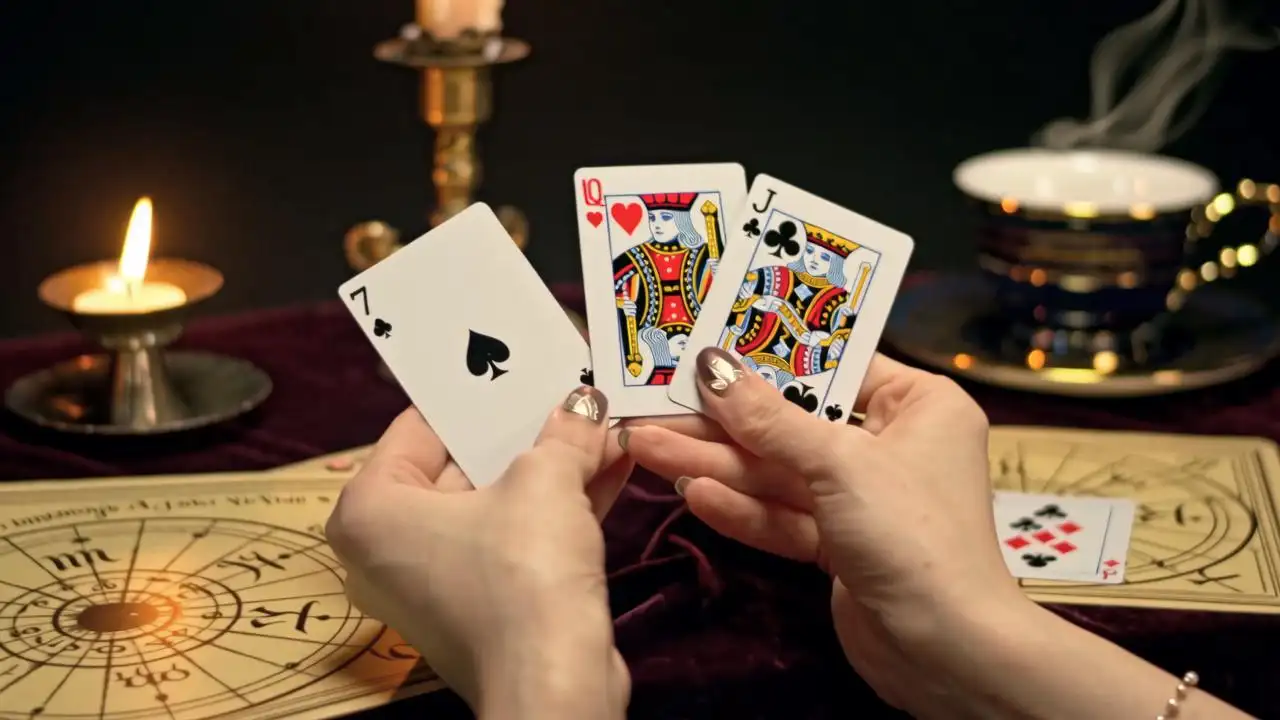
Ready to begin your journey into fortune telling spreads? Start simple. Even daily one-card draws can yield meaningful insights when approached with intention.
For more complex inquiries, create custom spreads. For love questions, try a “Heart Spread”: two outer cards representing each partner, a center card showing the relationship dynamic. For career guidance, lay out five cards: Current Role, Strengths, Challenges, Opportunities, and Outcome.
Always cleanse your deck before use—by moonlight, smoke, or silent meditation—to clear residual energies. And remember: the best fortune telling spreads are those tailored to your unique query, not rigid formulas.
To elevate your practice, synchronize your readings with celestial movements. The Moon governs intuition, making lunar phases ideal timing tools for playing card divination.
Even more powerful is linking suits directly to your natal chart. If you have a strong fire presence (many planets in Aries, Leo, Sagittarius), club cards may represent areas where you naturally thrive—or where ego struggles arise. Conversely, someone with dominant air signs might find spade cards recurring in communications-related readings.
Apps like TimePassages or websites such as Astro.com allow you to generate free natal charts. Once you know your elemental balance, you can interpret repeated suits as reflections of your innate strengths or karmic lessons.
Imagine pulling the Queen of Hearts during Venus retrograde in Pisces—a double water influence amplifying themes of forgiveness and unconditional love. Or drawing the Ten of Diamonds during a Jupiter transit in Taurus, signaling unexpected financial gain. These synergies transform random draws into synchronistic messages.
By merging timeless wisdom with cosmic awareness, astrology and playing cards offer a holistic system for navigating life's mysteries. Whether you’re exploring your destiny or seeking clarity in chaos, cartomancy remains a deeply personal and profoundly insightful art.
Disclaimer: This article contains information related to Astrology and esoteric practices for entertainment and educational purposes only. The content provided herein, including interpretations of playing card divination, cartomancy meanings, fortune telling spreads, and astrology and playing cards, is not intended as professional advice in psychology, medicine, finance, or any regulated field. Readers are encouraged to make decisions based on their own judgment and, when appropriate, consult licensed professionals. The author and publisher disclaim liability for any actions taken based on the material presented in this article.
Morgan Delaney
|
2025.12.24


